Explainer
How to Explain AI to a Child
Published August 18, 2026 · By the Kidgeni team
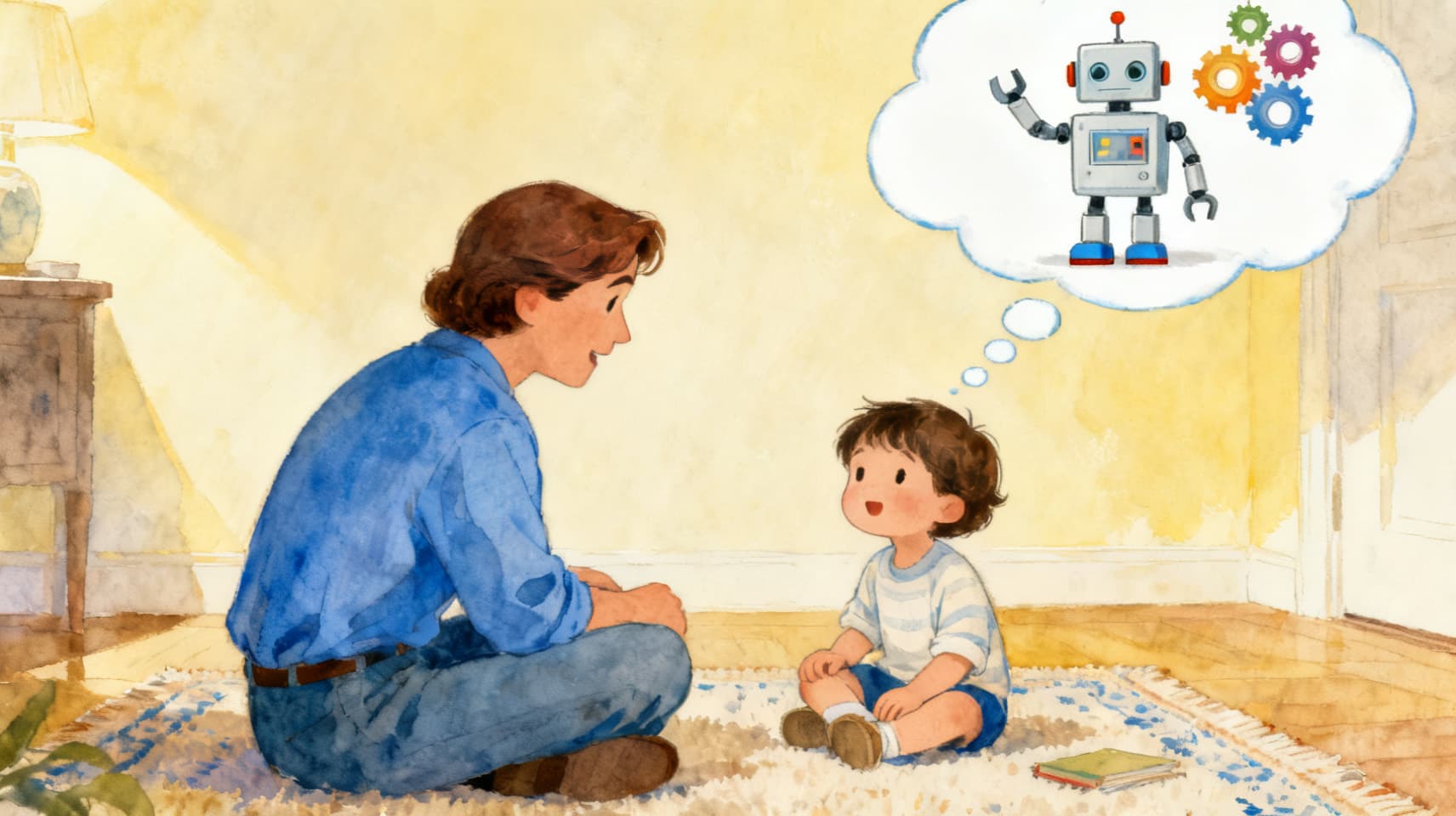
Tell your child that AI is a computer program that learned from millions of examples of things people made — words, pictures, sounds — and uses those examples to make very good guesses. It isn't alive, it doesn't have feelings, and it can be wrong; it's a tool, like a very fancy calculator for words and pictures. How much detail you add depends on their age — here are scripts for 5, 7, and 10.
The one idea to get right at every age
Whatever age your child is, the core idea is the same: AI learned from examples, and it guesses. It doesn't know things the way people do, it doesn't want anything, and it isn't magic — even when it feels like magic. Kids who get this one idea early are harder to fool, less likely to be scared, and much better at using AI as a tool instead of treating it as a friend or an oracle.
Everything below is a variation on that idea, tuned to what each age can hold onto.
For a 5-year-old: the robot that looked at a million pictures
Say this
“You know how you learned what a dog looks like by seeing lots and lots of dogs? The computer did that too — but it looked at a million, billion pictures. So when we ask it for a dog wearing a party hat, it makes a brand-new picture by remembering all the dogs and all the party hats it ever saw. It's not alive — it's a machine that's really, really good at remembering and mixing.”
At five, don't fight the magic feeling — redirect it. 'Isn't it amazing what people built?' keeps the wonder while planting the seed that people made this. If they ask whether the computer is alive, be plain: no, it doesn't eat, sleep, feel happy, or feel sad. It's a machine, like the washing machine — just one that works with pictures and words instead of socks.
For a 7-year-old: the guessing machine
Say this
“AI is a guessing machine. People showed it most of the words and pictures on the internet, and it got incredibly good at guessing what comes next. When you ask it a question, it isn't looking up the answer — it's guessing the answer one word at a time, based on everything it read. That's why it's usually right, and also why it's sometimes confidently wrong — like a friend who read every book but sometimes mixes them up.”
Seven-year-olds can handle — and love — the idea that the computer can be wrong. Make a game of it: ask an AI something your kid knows better than anyone, like details about their favorite obscure dinosaur, and let them catch its mistakes. Being the fact-checker teaches the single most important AI habit there is.
This is also the age to introduce the difference between guessing and knowing: 'You KNOW what you had for breakfast. The computer can only guess what breakfasts are usually like.' It's a clean line a seven-year-old can repeat back.
For a 10-year-old: patterns, training, and why it gets weird
Say this
“AI is a program trained on enormous amounts of text and images made by people. Training means the program tuned billions of little dials until its guesses matched the examples. So it doesn't understand things the way you do — it's completing patterns. That's why it can write a poem in seconds but also confidently make up a fact, and why what it says can carry the same mistakes and unfairness as the stuff it learned from.”
Ten-year-olds can go one level deeper on three things. First, hallucination: the AI never says 'I don't know' on its own — it fills the gap with something plausible, so important answers get checked. Second, bias: if the examples it learned from were unfair, its answers can be unfair too — which is a people problem, not a computer problem. Third, incentives: some apps want your attention for as long as possible; noticing when a chatbot is being engaging versus being useful is a superpower.
- Ask them: 'How would you check whether the AI is right about this?' — the question matters more than any answer.
- Show them the same prompt giving two different answers, and ask why a guessing machine would do that.
- Let them explain it back to a younger sibling — teaching it is the real test.
The best explanation is letting them make something
Explanations stick when kids get to poke the thing. Ten minutes of describing a picture and watching an AI draw it teaches more about 'it guesses from examples' than any script — especially when the guess is wonderfully wrong, the dragon gets five legs, and your kid says 'that's not what I meant' and refines the idea. That refining loop is the whole lesson: the human imagines and decides; the tool drafts.
Whatever tool you use for this, use one built for kids: moderated both ways, no chat with strangers, and controlled by you. (That's what we build Kidgeni to be — but the advice stands wherever you land.)
Questions parents ask next
Is AI alive? What do I say when my kid asks?
No — and say it plainly: AI is not alive, has no feelings, and doesn't know your child exists between conversations. It's a program that predicts words and pictures. Kids under about 8 genuinely wonder, so a clear 'it's a machine people built, like a very clever calculator' beats a hedge.
What age should kids learn about AI?
As soon as they're using devices that contain it — which for most kids is now. A five-year-old can grasp 'it learned from examples'; a seven-year-old can grasp 'it guesses and can be wrong'; a ten-year-old can handle training, hallucination, and bias. Match the depth to the age rather than waiting.
Will talking about AI's mistakes scare my child?
Usually the opposite. 'The computer sometimes guesses wrong' makes AI less mysterious and less authoritative, not scarier — and it gives kids the fun job of catching it. Fear tends to come from vagueness, not from honest mechanics.
Should I let my child use AI chatbots?
General-purpose chatbots aren't built for children: their safety rules, content, and data practices assume adults. If your child wants to create with AI, choose kid-specific tools where a grown-up owns the account, everything is moderated, and there's no open-ended stranger chat — and for open chatbots, sit alongside.
Let them poke it — safely
The fastest way for a kid to understand AI is to make something with it. Kidgeni is the moderated, grown-up-controlled place to do exactly that.