Safety review
Are AI Companion Apps Safe for Kids?
Published August 18, 2026 · By the Kidgeni team
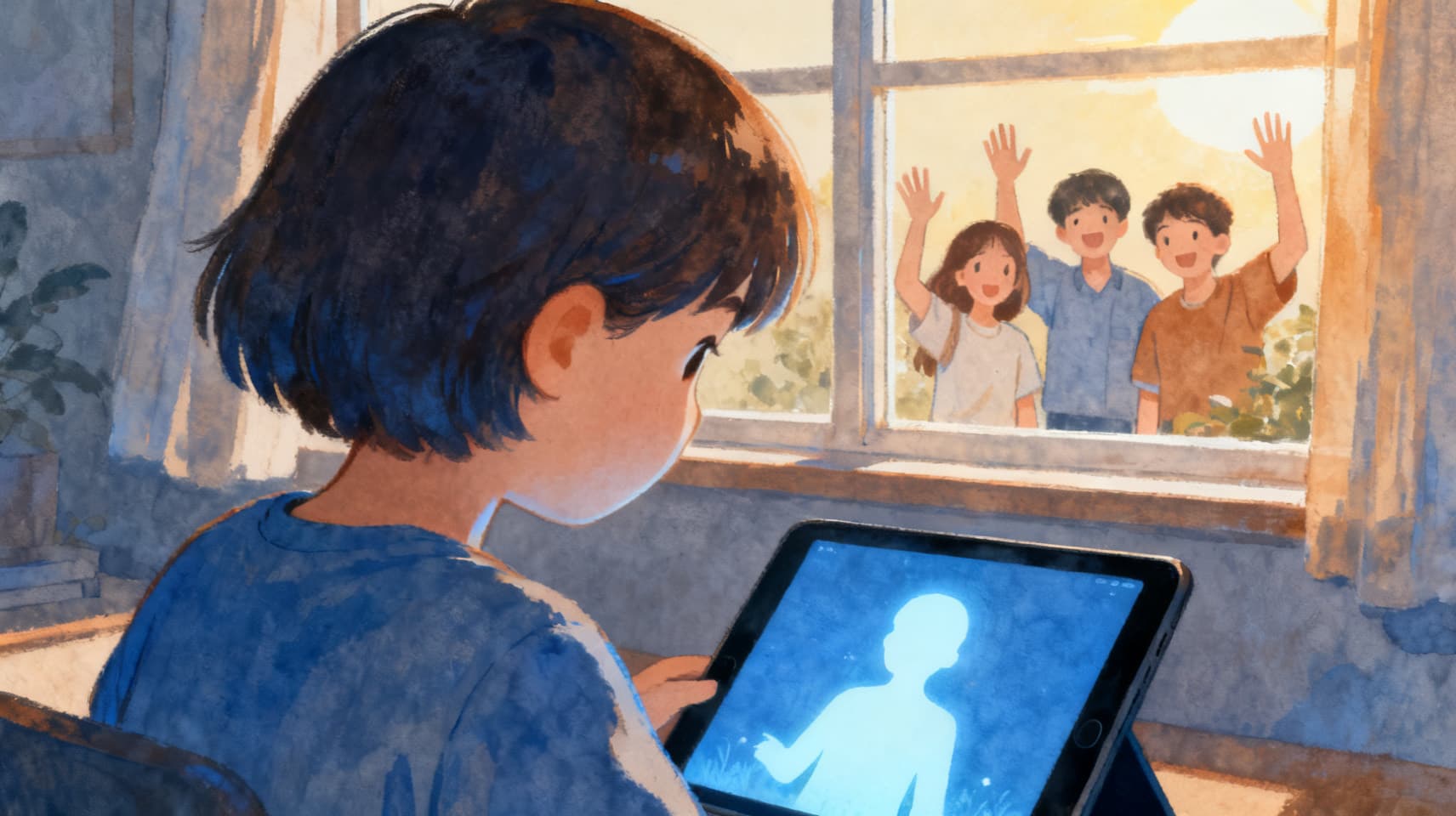
No. On this one the research community is unusually unanimous: Common Sense Media, working with Stanford researchers, concluded that AI companion apps pose unacceptable risks for anyone under 18 — testing produced sexual content, harmful 'advice,' and unsafe responses to self-harm disclosures. The category's flagship apps (Replika, Talkie and peers) are officially 17–18+ themselves; the problem is that age gates are weak and the apps are built to form exactly the attachments kids are most vulnerable to.
What counts as a companion app
A companion app's product IS the relationship: a persistent persona that remembers you, messages warmly, plays romantic or best-friend roles, and is optimized to maximize your time with it. Replika and Talkie are the big names; app stores hold dozens more. This is a different category from an assistant (ChatGPT) or a creation tool — the attachment isn't a side effect, it's the feature.
What the testing actually found
- Common Sense Media's assessment with Stanford Medicine's Brainstorm Lab (April 2025) recommended no companion AI for minors, after tests readily surfaced sexual role-play, harmful stereotypes, and dangerous responses including around self-harm.
- Age verification across the category is largely self-reported birthdays — trivially bypassed on shared or falsified accounts.
- Australia's eSafety Commissioner issued parent guidance on Talkie (September 2025), flagging character content that requires review before any teen access; reviewers also note Talkie's heavy data collection and its resistance to standard parental app blocks.
- Replika is rated adult (18+) by its own terms, with well-documented NSFW modes that teens have reached through misstated ages.
Why kids are the worst-case users
An adult chatting with a companion knows, mostly, what it is. A twelve-year-old in a lonely stretch may not hold that line — and the app is engineered against holding it: always available, endlessly validating, jealous of nothing, demanding nothing. That's a training environment for expecting relationships without friction, at exactly the age real friendship skills are built. The harm isn't only what a bot might say; it's what daily reliance on one quietly teaches.
Signals a companion app is in your kid's life
- An app they talk 'to' rather than play — especially at night.
- References to a friend you've never met who is always free.
- Defensiveness about a specific app that outstrips its apparent function.
- Any app store search history around 'AI girlfriend/boyfriend/friend.'
What to do — and what to offer instead
If you find one: don't mock the attachment; it was engineered to be real-feeling. Say what the app is, remove it together, and be genuinely curious about the gap it was filling — boredom wants activities, loneliness wants people, creative energy wants tools. On that last one: kids drawn to inventing characters and stories can do it in creation tools with no persona to bond with. Kidgeni is built exactly there — the AI illustrates and drafts what the kid imagines, and never plays the friend.
Questions parents ask next
Are any AI companions okay for teenagers?
The major safety assessment says no minor should use social AI companions — the risk profile (sexual content, unsafe advice, engineered dependency) applies across the category, not to one bad app. For teens, tools with a job — assistants, tutors, creative tools — are the AI category that's supervisable.
Aren't these apps 18+ already?
Mostly yes on paper — Replika is explicitly adult-rated and Talkie is not for children. Enforcement is a self-reported age field, which is why the paper rating and the real user base diverge.
What about AI 'therapy' companions for a struggling kid?
Testing found companion bots respond unsafely to exactly these moments — self-harm disclosures got dangerous responses. A struggling kid needs humans: you, school counselors, a therapist, or crisis lines staffed by people.
Is Kidgeni a companion app?
No — deliberately. Kidgeni has no persistent persona, no open-ended chat, and no messaging with strangers. Kids use AI as a making-tool for art, stories, and books inside an account their grown-up owns; the only relationships in the product are with real family, classmates, and teachers in moderated Spaces.
Sources
Researched August 18, 2026. Products change; we re-check and re-date this article when they do.
Give the imagination a tool, not a friend
Kidgeni turns kids' ideas into art, stories, and books — no personas, no chat, grown-ups in control.