Explainer
Does AI Art Help or Hurt Kids' Creativity?
Published August 18, 2026 · By the Kidgeni team
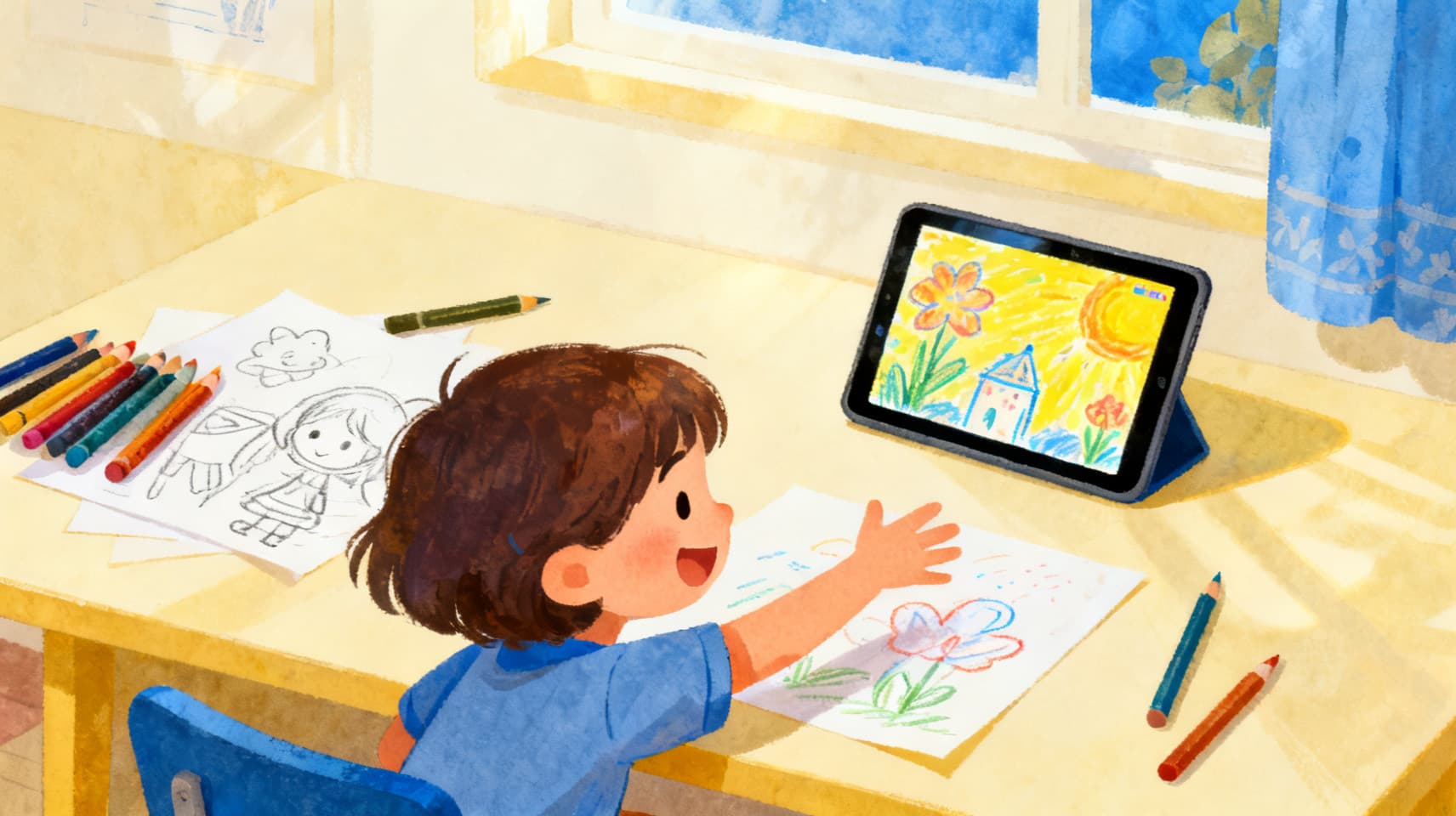
Both outcomes are real, and the deciding variable is not the tool — it's whether the child stays the author. Used as a vending machine ('make me a dragon', done), AI art can flatten creative effort. Used as a studio assistant the kid directs — imagining, describing, judging, revising — it exercises exactly the creative muscles that matter and removes a barrier (drawing skill) that makes many kids quit art entirely. We build an AI art tool for kids, so discount us accordingly; here is the strongest version of each side.
The strongest case that it HURTS
- Struggle is the point: creativity research consistently ties growth to effortful making. If a machine delivers a polished dragon in nine seconds, the child skips the thousand imperfect dragons that build both skill and grit.
- Taste without craft: kids may learn to want good things without learning to make anything — consumers of their own imagination.
- The comparison trap: a six-year-old's wobbly marker dragon can feel worthless next to the machine's, discouraging exactly the hand-drawing that most builds fine motor skill and patience.
- Frictionless is forgettable: what comes easy is valued cheap; a kid who generates fifty images may treasure none the way they treasure one labored crayon masterpiece.
The strongest case that it HELPS
- The bottleneck was never imagination: most kids quit art because their hands can't produce what their heads see. AI removes the execution wall, so the imagining — the actually scarce skill — gets unlimited reps.
- Iteration becomes cheap: 'that's not what I meant' → refine → try again is the professional creative loop, and AI lets an eight-year-old run it dozens of times an hour.
- Description is composition: to get the picture they want, kids must decide subject, mood, style, and detail — art direction, a real and durable creative skill.
- It feeds the other making: in practice kids bounce from generated art into stories, books, and yes, hand drawings of the characters they invented — the tool starts fires rather than replacing them.
What the research actually supports
Direct long-term studies on children and generative art barely exist yet — anyone claiming certainty is selling something. The adjacent evidence is more modest: creativity research supports both that effortful practice matters AND that lowering barriers to entry increases creative participation; tool studies (from cameras to synthesizers to Photoshop) repeatedly show new media panics fading into new art forms. The honest reading: usage pattern beats tool category.
The usage patterns that decide it
- Kid describes, machine drafts, kid judges and revises → creativity exercised.
- One prompt, take the first output, next → creativity bypassed.
- AI art AND paper both alive in the house → complements; the generated dragon becomes tonight's drawing reference.
- Every idea goes to the machine first → time to rebalance.
- They talk about what they MADE → healthy authorship. They talk about what it GAVE them → vending machine.
How we've tried to build for the good pattern
This question is why Kidgeni is shaped the way it is: the kid's idea is always the starting point, revision is the core loop, creations feed into stories and books the child authors, and coloring pages deliberately route back to crayons and paper. We'd rather be the studio than the vending machine — and whichever tool your family uses, that's the property to look for.
Questions parents ask next
Will my kid stop drawing by hand if they use AI art?
Not automatically — and often the opposite, when generated art becomes reference material for hand drawing. The risk pattern is replacement (screen instead of paper always); the healthy pattern is rotation. Parents set that rotation, not the app.
Is using AI art 'cheating' at art?
It's a different activity, the way photography is different from painting — with its own real skills (conceiving, describing, directing, curating). A kid should know which activity they're doing; both can be honest.
What age is AI art appropriate to start?
Around 5 with a grown-up alongside works well: young kids can speak their ideas before they can draw or type them. What matters more than starting age is the setup — moderated kid tools, adult in the loop, and paper still in the house.
How do I keep my kid the author?
Ask author questions: 'What do you want it to feel like? What would you change?' Praise decisions rather than outputs. And keep projects — a book, a character's world — over one-off generations; projects force the creative loop.
Built for young authors, not vending
Kidgeni keeps kids in the director's chair — imagine, refine, and turn art into stories and books.