Explainer
Screen Time for Kids: What Matters More Than the Hour Count
Published August 19, 2026 · By the Kidgeni team
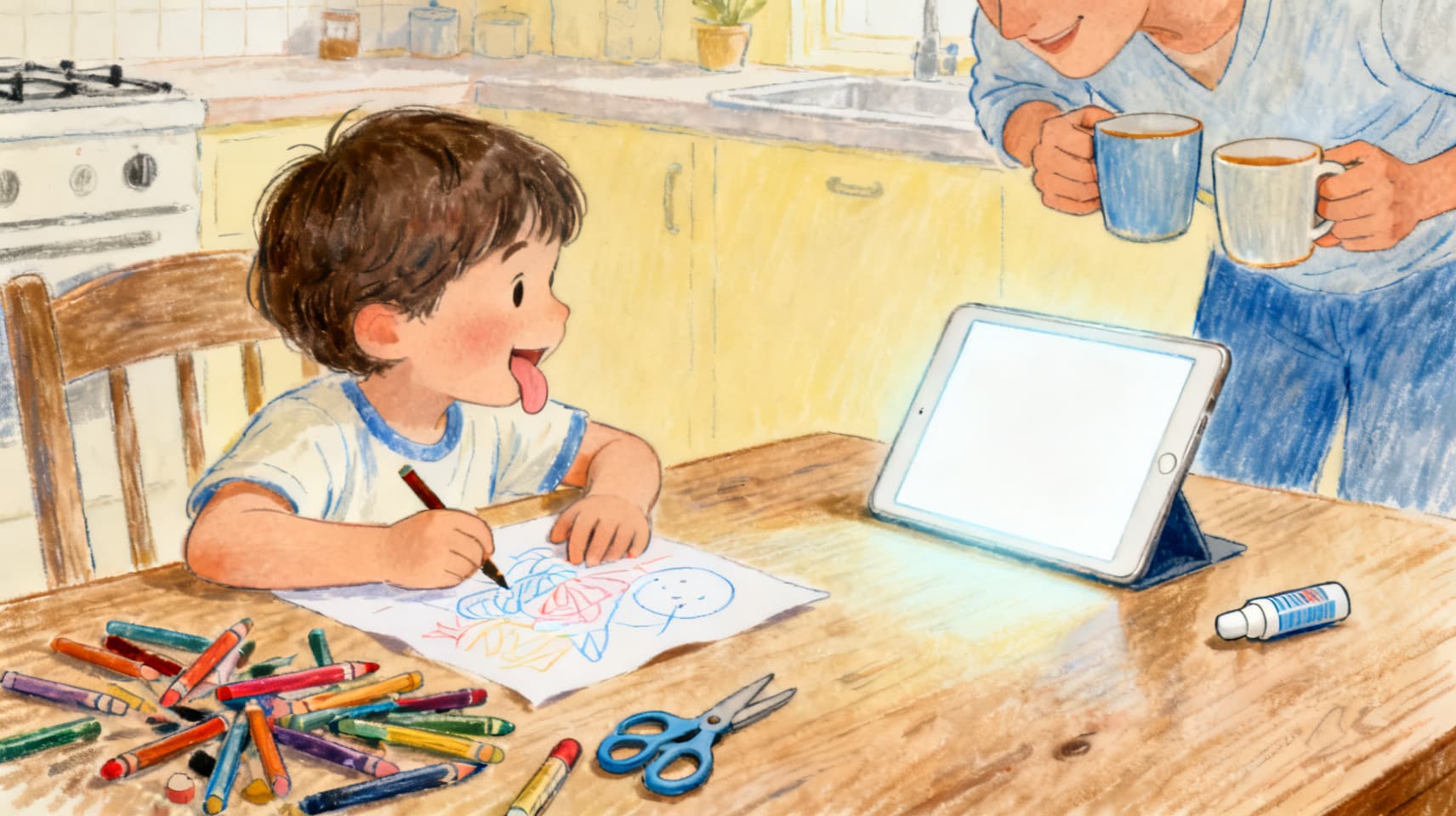
For school-age kids, the hour count is no longer the headline: the American Academy of Pediatrics has moved from blanket time limits to asking what a child is doing on the screen and what it's crowding out. The distinction that does the most work is creating versus consuming — forty minutes making a comic is not the same forty minutes as autoplay — and the practical tool is a family media plan you actually write down.
The question pediatricians stopped asking
For years the rule of thumb was a two-hour daily cap. The AAP's current guidance, from its Center of Excellence on Social Media and Youth Mental Health, retires the single number for school-age kids in favor of the '5 Cs' — because a flat cap treats a drawing app, a math game, and an autoplay rabbit hole as the same thing, and every parent knows they aren't.
- Child — kids differ; the right call for your anxious 7-year-old isn't the right call for your bulldozer 10-year-old.
- Content — WHAT they watch or play matters more than how long.
- Calm — a kid should be able to settle feelings and fall asleep without a screen.
- Crowding out — is media displacing sleep, outdoor play, reading, or family time? That's where the real harm hides.
- Communication — talk regularly about what they watch, play, and make.
What the numbers actually say
Common Sense Media's most recent census of 8-to-12-year-olds found about five and a half hours of entertainment screen media a day — so if your household is over the old two-hour line, you have plenty of company. The research on harm, meanwhile, is less apocalyptic than the headlines: the huge 'Goldilocks' study of over 120,000 adolescents found moderate use associated with slightly HIGHER well-being than none, with problems appearing only at heavy extremes. And a landmark 2019 analysis of 355,000 teens found screen use explaining about 0.4% of the variation in well-being — statistically comparable to eating potatoes. Screens are neither poison nor vitamin; what varies is what the time is made of.
Create vs. consume: the distinction that earns its keep
The strongest thread in the research is the difference between passive and active screen use. Passive consumption is where displacement bites — it expands to fill any container and asks nothing back. Active, creative use (drawing, building, writing, making music, coding) behaves more like a hobby that happens to run on a screen: it has a goal, an output, and an end. Studies of preschoolers find passive and interactive screen time relate differently to attention and executive function, and the AAP's own Content and Crowding-Out lenses point the same way.
Honesty requires the caveat: no study shows creative screen time is transformative on its own, and 'my kid is CREATING' can launder plenty of aimless tapping. The test is simple — is there a thing at the end? A drawing, a story, a fort blueprint, a book? Making leaves evidence.
The little-kid exception
The hour-limit retirement applies to school-age kids. For the youngest, hard guidance stands: the AAP recommends no media before roughly 18–24 months except video chat, and about an hour a day of high-quality programming, co-viewed, for ages 2–5. The WHO is stricter still — no screen time under age one, and no more than an hour of sedentary screen time for ages 2–4, with less always better.
A framework you can actually run
- Write a family media plan (the AAP has a free builder) — screen-free times and zones, agreed content standards, and where devices sleep.
- Sort your kid's screen hours into creating vs. consuming for one week — just observe. Most families find one big passive block that nobody actually values.
- Trade, don't ban: swap the lowest-value passive block for a making block. Same screen, different verb.
- Co-engage where you can — the research on co-viewing is old and boring and still right.
- Judge weeks, not days. A rainy Saturday movie marathon inside a balanced week is a memory, not a failure.
Try saying this
“Screens are fine in this house — we just care what they're FOR. If you're making something, I'll happily give you more time. If it's just autoplay, that's what we keep short.”
The AI wrinkle
One more reason the create-vs-consume lens matters now: AI arrived inside kids' screen time. Common Sense Media's 2026 census found 81% of 9-to-12-year-olds already use AI — yet more than 4 in 10 kids say no parent has ever talked with them about AI safety. The same verb test applies with extra force: AI that helps a kid MAKE things (art, stories, books) is a different animal from AI designed to keep a kid talking. Our reviews of the specific tools kids ask for live in the Learn hub, and our safety checklist covers the conversation itself.
Questions parents ask next
So is there any recommended hour count for a 9-year-old?
Not from the AAP anymore. The guidance is the 5 Cs plus a written family media plan: protect sleep, movement, reading, and family time first, hold content quality, and the remaining number takes care of itself. If you want a personal ceiling as a backstop, that's a fine parenting call — it's just no longer the medical headline.
Does creative screen time count against the limit?
In the create-vs-consume framework you weight it differently rather than exempting it. Making something still shouldn't crowd out sleep or the playground — but an hour with an output at the end (a drawing, a story, a book) is doing different work than an hour of autoplay, and your rules can say so out loud.
What actually counts as 'creating'?
The test is the thing at the end: drawing or animating, writing or dictating a story, building in a sandbox game with intent, coding, making music, editing photos into a card for grandma. Watching other people do those things is consuming — which is fine, in its place.
Where does AI fit into screen-time rules?
Treat it by the same verb test. Creation-oriented AI tools a grown-up manages (art, story, and book makers) belong on the creating side of the ledger; open-ended companion chatbots are engineered for time-on-app and are the one category safety researchers say minors should skip entirely. Our 'Is AI Safe for Kids?' review covers the categories one by one.
Sources
Researched August 19, 2026. Products change; we re-check and re-date this article when they do.
- AAP / HealthyChildren — Kids & screen time: how to use the 5 Cs of media guidance
- WHO — Guidelines on physical activity, sedentary behaviour and sleep for children under 5
- Common Sense Media — Census: media use by tweens and teens
- Przybylski & Weinstein — the 'Goldilocks' study (Psychological Science)
- Orben & Przybylski — The association between adolescent well-being and digital technology use (Nature Human Behaviour)
- Children and Screens — Are some types of screen time better than others?
- Common Sense Media — 2026 census: AI use by tweens and teens
Make screen time the making kind
Kidgeni turns 'more screen time?' into art, stories, and real printed books — moderated end to end, with a grown-up owning the account.