For educators
Teaching Kids About AI: What to Cover at Each Age
Published August 21, 2026 · By the Kidgeni team
AI literacy is not coding, and it starts younger than most curricula assume. The published frameworks agree on the shape: children need to recognise when they are talking to a machine, understand that it learned from examples rather than knowing things, judge whether its output is any good, and grasp that people made choices about it. For ages 5-7 that is mostly the first idea; by 11-12 a child can genuinely evaluate output and discuss bias. The one thing to teach at every age: it is software, not a friend.
The frameworks worth knowing
You do not need to invent this. Three published frameworks converge, which is reassuring: UNESCO released AI competency frameworks for students and teachers at Digital Learning Week 2024, organised around a human-centred mindset, AI ethics, AI techniques and applications, and AI system design, each at three mastery levels. The OECD and European Commission published the AILit Framework in June 2026, defining AI literacy across four domains — Engage with AI, Create with AI, Manage AI, and Shape AI. And the US-based AI4K12 initiative offers the most classroom-portable version: Five Big Ideas (perception, representation and reasoning, learning, natural interaction, and societal impact).
Strip them down and the same four questions survive for young children: How do I know if this is a machine? Where did it learn that? Is it any good? Who made it this way? Everything below is those four questions at the right altitude.
Ages 5-7: it is a machine, and it guesses
At this age the goal is a mental model, not vocabulary. Children this young readily attribute feelings and intentions to anything that talks back, which is precisely the misconception to head off. Keep it concrete and physical.
- Teach the one-sentence definition: 'It's a computer program that looked at millions of pictures and words, so it can make new ones — but it doesn't know things the way you do.'
- Play 'real or made-up?' with a few AI images: hands with too many fingers, wobbly text, a cat with five legs. Kids love catching mistakes, and catching mistakes IS the skill.
- Make something together where the child directs and the AI executes — they describe, it draws, they decide if it is right. Authorship stays with the child.
- Say the friendship line out loud, early and often: it is not a person, it does not have feelings, and it is not your friend.
Ages 8-10: it learned from examples, and it can be wrong
Now the 'learned from examples' idea can land properly, and with it the first real critical stance. This is also the age when children start using AI for schoolwork whether or not anyone taught them how — Common Sense Media's 2026 census found 81% of 9-to-12-year-olds already using AI, with schoolwork the second-most-common use after fun.
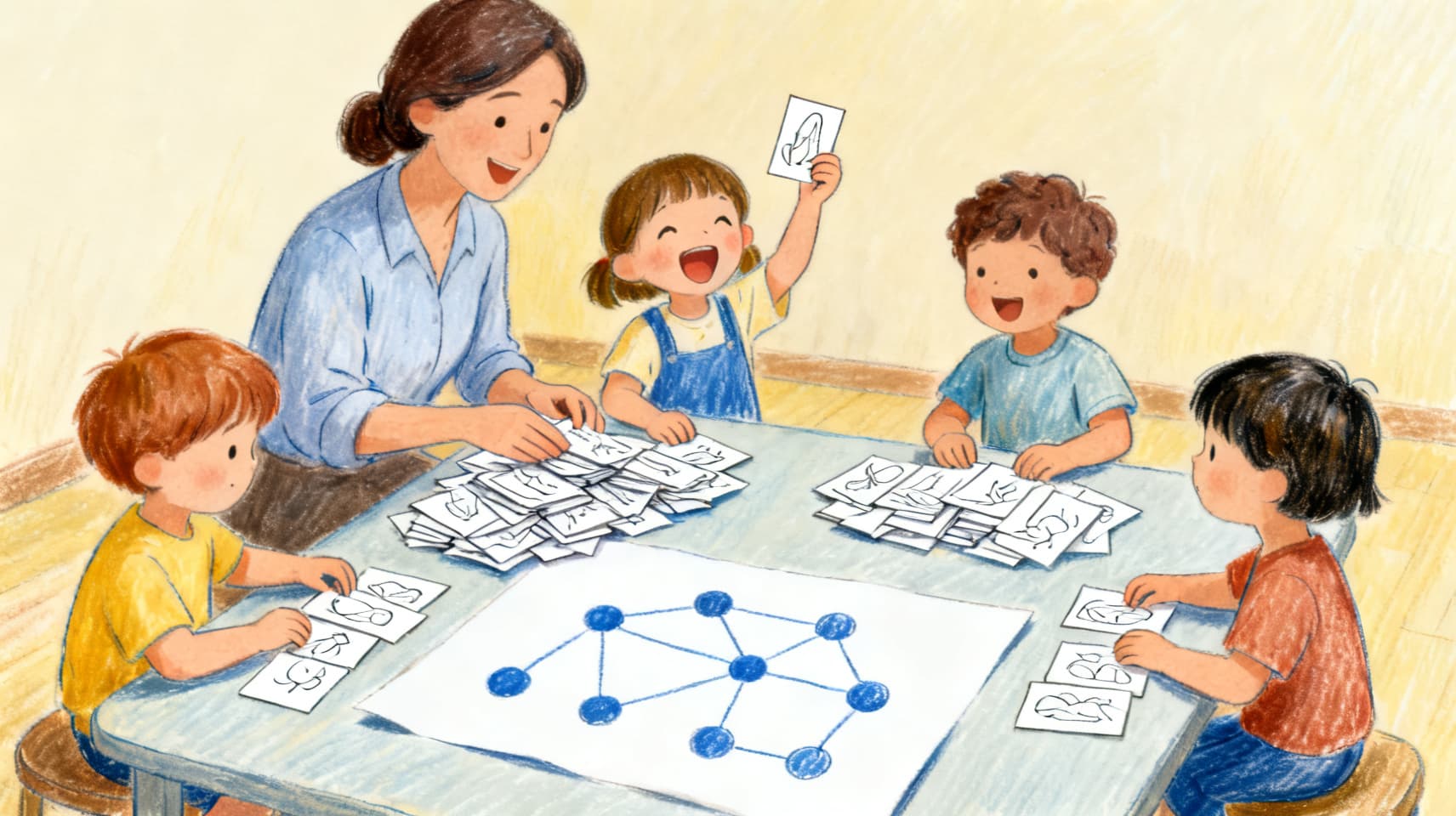
- Demonstrate training data with something physical: sort 20 drawings into 'cat' and 'not cat', then discuss what a machine fed only YOUR drawings would think a cat looks like.
- Introduce hallucination by name and by demo — ask a chatbot something in your family's or town's obscure history and check its confident answer against a real source.
- Set the disclosure habit: if AI helped, say so in a sentence. Make it consequence-free and it becomes automatic.
- Try the same prompt three ways and compare outputs. Words in, pictures out — that is prompt-craft, and it is the durable skill.
Ages 11-12: people made choices about this
Preteens can handle the societal layer, and they are interested in it — fairness is a live topic at this age. This is where AI literacy becomes citizenship rather than tool use.
- Bias from data: ask an image generator for 'a doctor', 'a nurse', 'a criminal' and discuss what came back and why. It is a five-minute activity that lands permanently.
- Deepfakes and provenance: show that convincing fake video exists, then look at how platforms label AI content — and how often labels are missing.
- The attention question: some products are designed to keep you talking. Ask what a chatbot company earns from a longer conversation.
- Data literacy: what happens to what you type? Who keeps it? Under the updated COPPA rules, using a child's data to train a model requires separate parental consent — a rule a 12-year-old can absolutely understand.
- Let them argue the other side: is using AI to write an essay cheating? Have them defend both positions. That is the assessment.
The conversation nobody is having
The most striking number in Common Sense Media's 2026 census is not adoption — it is that more than 4 in 10 kids say no parent has ever talked with them about AI safety. In classrooms the equivalent gap is teacher training: RAND found district AI training reaching 67% of low-poverty districts by fall 2024 versus 39% of high-poverty ones. Ten minutes of honest conversation outperforms any filter, and it is the one intervention available to every adult regardless of budget.
The line worth repeating at every age
“AI is a tool, like a really fancy art supply. It's great at making things WITH you. It's not a person, it doesn't have feelings, and it doesn't get to know your secrets. If an app ever feels like a friend, come tell me.”
- How to explain AI to a child (age-banded scripts)
- AI in the Classroom: ground rules that actually work
- Is AI safe for kids? The honest answer
Questions parents ask next
Does teaching AI literacy mean teaching coding?
No. Every major framework treats them as different: AI literacy is understanding, using, evaluating, and questioning these systems. A child can be genuinely AI-literate without writing a line of code — and a child who codes may still believe the chatbot has feelings.
What age should this start?
Around five, in the simplest form: this is a machine, it guesses, and it is not a person. Children are already encountering AI in voice assistants and recommendation feeds well before anyone formally introduces it, so the choice is whether the first explanation comes from you or from the product.
How do I teach this if I don't understand AI myself?
The four questions carry you: Is this a machine? Where did it learn that? Is the answer any good? Who made choices about it? You do not need to know how a transformer works to ask those with a child — and modelling 'let's find out' is better teaching than expertise.
Is there a curriculum I can just use?
AI4K12's Five Big Ideas is the most classroom-portable starting point for US K-12, UNESCO's student competency framework is the most complete internationally, and the OECD/EC AILit framework published in June 2026 is the newest. All three are free to read and none require a purchase.
Sources
Researched August 21, 2026. Products change; we re-check and re-date this article when they do.
- UNESCO — AI competency frameworks for students and teachers
- OECD / European Commission — AILit Framework, defining AI literacy for schools (June 17, 2026)
- AI4K12 — Five Big Ideas in AI for K-12
- Common Sense Media — 2026 census: AI use by tweens and teens (June 2026)
- RAND American School District Panel — district AI training for teachers
Learn it by making something
The fastest way to teach how AI works is to direct it: your class describes, it draws, they decide if it's right. Kidgeni for Schools makes that safe to do with a whole roster.