Explainer
What Is Generative AI? A Parent's Guide
Published August 18, 2026 · By the Kidgeni team
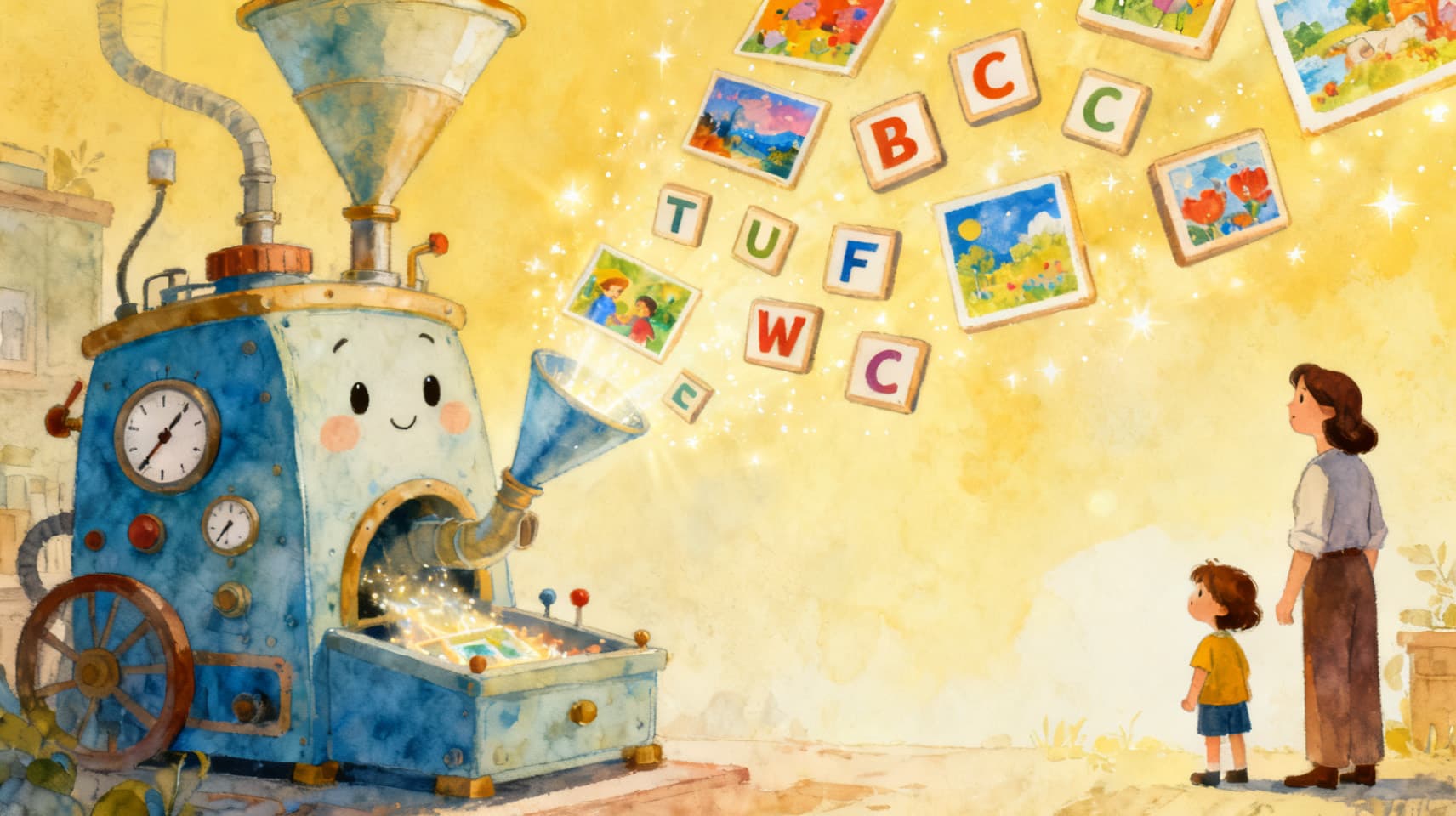
Generative AI is software that creates new things — text, images, music, video — instead of just finding or sorting existing ones. It works by studying enormous collections of human-made examples and learning the patterns well enough to produce convincing new combinations. It doesn't think, know, or intend anything; it predicts, extremely well. That one sentence covers most of what a parent needs to reason clearly about it.
'Generative' versus the AI you already knew
AI has been in your life for years — spam filters, map routes, autocomplete. Those systems classify or rank things that exist. Generative AI is the newer branch that MAKES things: ask for a poem about a grumpy walrus and you get a poem no one ever wrote. Same underlying math family, very different superpower — and very different questions for families.
How it actually works, minus the math
Training is pattern-compression at absurd scale: a model reads billions of sentences (or looks at billions of images) and adjusts billions of internal dials until it can predict what plausibly comes next. Generation runs that prediction forward — next word after word, or an image refined from noise toward 'what matches this description.' Two honest consequences follow: it can produce genuinely new combinations, and it can produce fluent nonsense, because plausible-sounding is exactly what it's optimized for.
The vocabulary your kid is already hearing
- Prompt — the instruction you give it. Writing good ones is a real (and teachable) skill.
- Model — the trained program itself (ChatGPT and Claude are chat models; image models draw).
- Training data — the human-made examples it learned from; its habits and blind spots come from there.
- Hallucination — when it fills a gap with confident invention; the reason 'check it' is a house rule.
- AI slop — low-effort generated content flooding feeds; kids use this word before parents do.
What it means for your family, practically
- Homework has changed: an essay is generatable, so the skill to protect is the thinking, not the typing. Many teachers now design around this; ask yours how.
- Seeing is no longer believing: photos, voices, and videos can be synthesized. Teach 'who posted this and how would we check?' the way past parents taught stranger-danger.
- Creation got a power tool: kids can illustrate their own stories, design characters, and make real books — supervised, this is the genuinely wonderful part.
- Data flows matter: whatever your kid types into a free general-purpose tool may be stored and used to train future models — a reason kid-specific, COPPA-conscious tools exist.
The mental model to install
Families do fine with generative AI when they treat it like a power tool: impressive output, real sharp edges, adult judgment required, and the human stays the author. Kids who learn 'it predicts from examples; I decide what's true and what's good' are equipped for every AI product that will arrive during their childhood — including the ones nobody has built yet.
Questions parents ask next
Is generative AI the same as AGI or 'sentient AI'?
No. Today's generative models are prediction systems without goals, awareness, or understanding. Debates about future artificial general intelligence are real debates — but the tool your kid touches today is statistics, not a mind.
Where does the training data come from?
Mostly from the public internet and licensed collections — human writing, art, and photos at enormous scale. That provenance is why copyright and fairness arguments around AI exist, and worth mentioning to older kids: the machine learned from people.
Why does it confidently make things up?
Because it generates the most plausible continuation, and 'I don't know' is rarely the most plausible continuation. Nothing inside checks facts unless a product adds that separately — so treat fluency and accuracy as different things.
What's the best first generative AI experience for a child?
Creating something concrete together — describing a picture and watching it appear, then refining it. It teaches prompting, iteration, and the guessing-machine nature in ten minutes. Use a kid-built, moderated tool for it; that's the niche Kidgeni is designed to fill.
The ten-minute hands-on lesson
Watch your kid's idea become art, and 'it predicts from examples' explains itself. Kidgeni is free to start.