Guide
The Comic-Strip Workshop: One Afternoon, One Comic Your Kid Wrote
Published September 1, 2026 · By the Kidgeni team
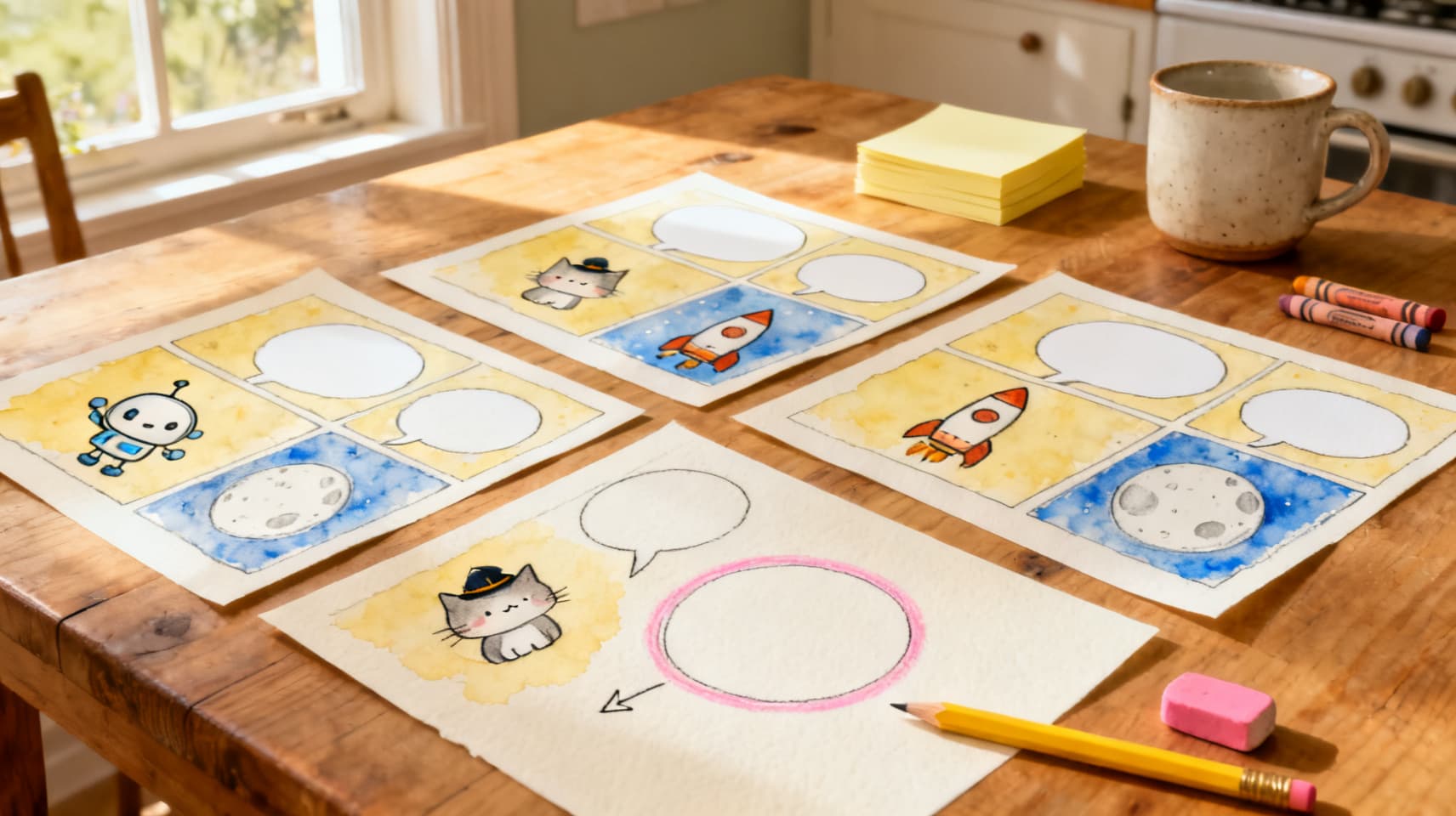
You can make a real comic with your child in about 45 minutes: five minutes on a premise, five to pick a hero and a style while the AI draws the cover and four pages, then twenty-five minutes on the only part that matters — your kid keeping, rewriting, or deleting every speech balloon. Print it at the end. The pictures are generated; the writing is theirs.
The smallest complete story a person can make is a comic. Cover, a handful of panels, words in balloons, an ending that makes someone ask what happens next. This workshop takes about 45 minutes, works for ages 5–12, and ends with a printed comic that has your child's name on it — because they wrote it.
Most “AI comic” projects for kids run through three apps and a stapler: one tool for the script, another for the pictures, a third to glue them together. Somewhere in there the child stops being the author and becomes the mascot. This one is arranged the other way round. The AI is the artist. The writer is your kid.
What you'll have at the end
- A cover
- Four illustrated pages
- Speech balloons your child actually wrote — not just approved
- A cliffhanger they chose
- A paper copy on the fridge, or a finished comic in their gallery
Screen time is the session itself, not an open tab afterwards. When the comic is printed, the laptop can close.
What you need
- About 45 minutes — 60 if this is their first time
- A grown-up-owned Kidgeni account. Kids sign in with a username and a PIN, never an email address.
- A printer, if you want paper. Not required; reading it on screen still counts.
- Optional: a pencil and a sticky note for the premise. Useful for five-year-olds who think faster than they type.
You do not need Canva, ChatGPT, a comic template PDF, or the ability to draw.
The rule that makes it a writing lesson
Before you start, say this out loud:
Say this before you open the laptop
“The computer is going to draw. You are going to write. If a balloon is boring, that's on us — we change it.”
Skip that sentence and your child will treat the pre-written balloons as the official story, and the afternoon becomes a coloring book with extra steps. The editable balloon is the whole point.
Minute by minute
0:00–5:00 — The premise, on a sticky note
Do this before you open anything. Ask three questions and write the answers down in their words:
- Who is this about? A cat, a robot, two best friends — not “me as a superhero” unless they insist.
- What do they want?
- What's in the way?
If they're stuck, steal one of these and let them remix it:
- My cat is a detective on the moon
- A robot who is scared of toast
- Two best friends find a dragon egg
- The hamster who runs the lost-and-found
- A pirate who cannot swim
Ages 5–7: they talk, you write the sticky note. Ages 8–12: they write it. Either way, resist the urge to improve the joke. The worse the toast-robot premise, the better the comic.
5:00–10:00 — Open the comic maker
Start a comic. Pick a hero that matches the sticky note, then a style your child can defend out loud — cartoon, claymation, crayon, comic, watercolor. The cover appears, and the first page opens behind it.
If the cover is wrong — the cat looks like a tiger, the moon looks like a beach ball — that's the first teaching moment: the machine guessed, so we ask again. One retry is plenty. Perfectionism at minute eight kills the afternoon.
10:00–35:00 — The writing, which is the whole workshop
Pages arrive with speech balloons already in them. Treat those balloons as a first draft from a very eager illustrator who cannot be trusted with dialogue. For each balloon, your child does exactly one of three things:
- Keep it — only if they can read it aloud without cringing
- Rewrite it — shorter is better. One breath per balloon.
- Throw it away — a silent panel is a real comic-book move, and kids feel like geniuses when they discover it
A few prompts that unstick a quiet kid:
- What would this character never say?
- Say it the way you'd say it to your brother.
- Can you make this balloon a question?
- What's the sound effect? (Don't be precious. “FWUMP” is literature.)
Ages 5–7: they dictate, you type, then they tap which balloon to keep — speaking the line is the writing. Ages 8–12: sit nearby and only interrupt if they're accepting every default. One nudge usually does it: would you actually say that?
This block is twenty-five minutes on purpose. If you finish early, they take a second pass at page three — the page that always goes mushy.
35:00–40:00 — The cliffhanger
The four pages end on a cliffhanger your child chooses from a short list. This is the bit they'll talk about at dinner, so let them pick the most unfair option. Sequels are how comics become a habit instead of a one-off craft. If they want to start volume two immediately, that's a different afternoon — write the choice on the sticky note and put it on the fridge.
40:00–45:00 — Read it out loud, then print
They read it, not you. If a balloon trips them, that's a rewrite, not a fluency problem — change the word. Then print if you can. A comic that exists on paper gets shown to a grandparent; a comic that lives in a browser tab does not.
Everything stays private by default. If they want to share it, it goes to a Space a grown-up owns — family or classroom — not the open internet.
What to say if they ask “did I really write this?”
Yes. The pictures are guesses from a machine that has seen a lot of pictures. The words are theirs. Here's the test: take the balloons out and what's left is a silent picture book anyone could letter. The comic only says what it says because your kid decided it.
If you want language for the bigger what-is-AI conversation, the age-banded scripts live in a separate guide. Don't stop the comic to deliver a lecture — one sentence is enough: it guessed the pictures, you decided the words.
- How to explain AI to a child (age-banded scripts)
- Does AI art help or hurt kids' creativity?
- The Parent's Guide to Kidgeni
If you're a teacher
Same workshop, a class code instead of a family login. Twenty-five kids can run it in one period because nobody needs an email address. You own the Space; students share when they're ready. The literacy standard you're covering is dialogue, not “we used AI.”
A useful constraint for a class: everyone keeps the same style, so the wall of printed comics looks like a proper issue.
What not to do
- Don't let the AI keep the balloons. That's the whole leak.
- Don't star the child as the superhero unless they ask. A comic about you is a different product, and it teaches a different lesson.
- Don't chase a prettier style for twenty minutes. One cover, then write.
- Don't skip the read-aloud. That's copy-editing, and kids will fix a line out loud that they'd never fix in silence.
What to make next weekend
If the comic worked, the natural boss level is a complete book — cover, middle, ending — with your child as author and art director. If they didn't want an ending at all, the story generator is the what-happens-next machine. And seven shorter activities, most of which end with the screen off, are already written up.
- The book maker for kids
- The AI story generator for kids
- AI art activities to do with your kids this weekend
Questions parents ask next
How does an AI comic-strip workshop for kids actually work?
The child picks a hero and a style. The AI draws a cover and four pages. Every speech balloon arrives as a draft the child rewrites. You print it at the end. The pictures are generated; the writing is theirs. That's the whole loop, and it fits in about 45 minutes.
Is this appropriate for a 5-year-old?
Yes, with you in the chair. Five-year-olds can speak the premise and the lines while you type. Kidgeni is built for roughly ages 5–12 inside an account a grown-up manages, and the read-aloud at the end still counts as their writing.
Won't the AI just write the comic for them?
Only if you let it. The maker fills the balloons so a blank page doesn't freeze a kid. The workshop rule is that every balloon gets kept, rewritten, or deleted on purpose. If they don't change a single line, you ran a demo, not a workshop.
Do we need ChatGPT or Canva too?
No. Multi-app comic stacks exist because the drawing and the lettering usually live in different tools. Kidgeni does the pages and the editable balloons in one place. A printer is the only extra, and even that is optional.
How much does it cost to try this afternoon?
Free to start. The Little Explorer plan includes 500 Sparks a month, and a comic spends Sparks like any other creation. You don't need a credit card to find out whether your kid will sit still for 45 minutes.
What if the pictures come out weird?
Good — wrong guesses are the easiest way to teach what AI actually is. Change the style once, or change one detail, then get back to the balloons. A slightly wrong robot is funnier than a perfect one.
Make the comic this afternoon
Forty-five minutes. Four pages. Their words. Start a comic free — no kid emails, no credit card.